The Backstop That Stalled: PJM's One-Time Auction for Data Center Power Runs Into FERC
PJM was supposed to open a six-week window on September 30 to buy 6.8 GW of new power plants for data centers on 15-year contracts. FERC approved the price cap, threw out the cost allocation, called the filing a mess, and the largest grid operator in the country put the whole thing on hold.
September 30 was supposed to be the day the bids arrived. For three weeks, developers with new gas turbines, batteries, and plant uprates across the 13 states and the District of Columbia served by PJM Interconnection were to offer into a one-time procurement unlike anything the grid operator had run: 15-year commitments for roughly 6.8 GW of new supply, bought outside the normal capacity market, to cover load that data centers are expected to add by June 2028.
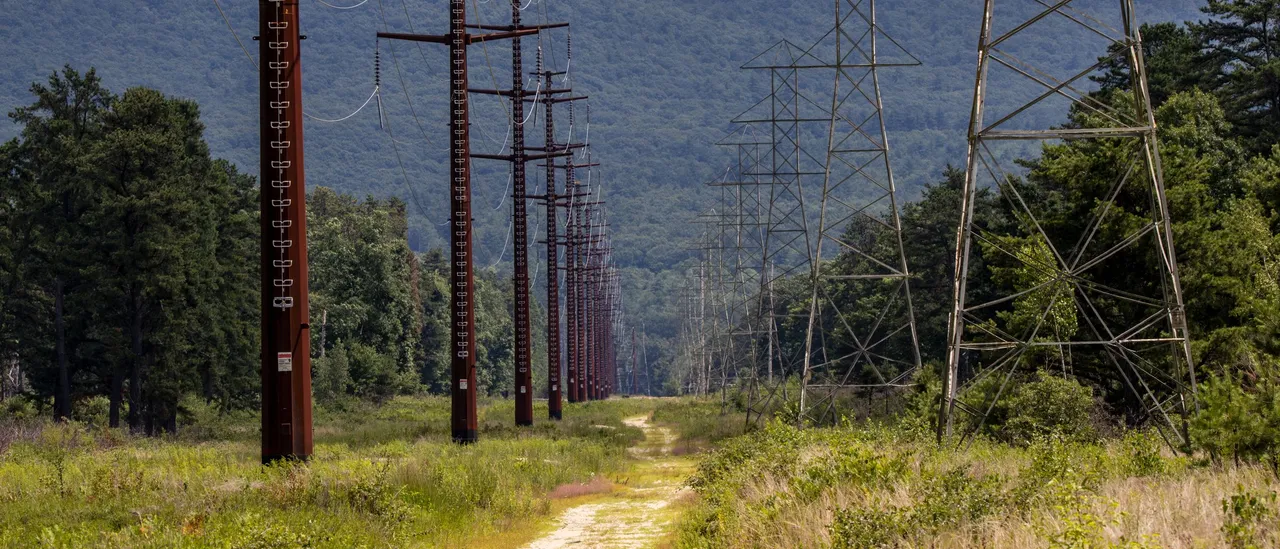
The window stayed shut. On September 29, the Federal Energy Regulatory Commission accepted most of PJM’s design and then suspended it, finding that the parts deciding who pays may be unjust and unreasonable. PJM said the next morning that the procurement would not open on schedule and that no new date has been set, according to Utility Dive. The transmission corridors through the Appalachian ridges will carry the same power next summer that they carry now, and the question the backstop was meant to settle, whether data centers or everyone else pays for new plants, is back in the states’ laps.
What a backstop auction actually is
PJM’s ordinary capacity market, the Base Residual Auction, pays generators to be available three years ahead of a delivery year, and every retail customer pays a share of the result; what the last five auctions did to household bills is covered in the ratepayer economics. A backstop is what happens when the ordinary auction fails to buy enough. PJM’s tariff already contained one, but it could only be triggered after three consecutive short auctions, as the Institute for Policy Integrity at NYU noted in comments to FERC. PJM proposed to skip the wait.
The design filed on July 31 in Docket ER26-3380 works like this. Only new resources may offer: new plants, uprates, repowerings, and storage able to reach commercial operation by June 1, 2032. Winners get commitments of up to 15 delivery years, through 2042/43. The auction is pay-as-bid, so each winner receives its own offer price, and PJM ranks offers first by earliest commercial operation date and then by lowest levelized cost, according to Sysotech’s summary of the tariff. The target equals the 2028/29 shortfall, 6,831 MW, minus any new capacity utilities can document through bilateral contracts with data centers, per Policy Integrity.
Payment runs through a contract for differences with PJM as counterparty. A winning resource offers into every future capacity auction as a price-taker; if the auction clears below its backstop price, PJM tops it up, and if it clears higher, the resource pays the difference back. The cap is $555/MW-day, applied to the megawatt-weighted average of all selected offers rather than to each bid, and set at 1.5 times the net cost of new entry, per Policy Integrity. The Natural Resources Defense Council put the potential outlay at up to $20 billion, per Utility Dive. PJM, as Latitude Media put it, is less an auctioneer than a buyer of last resort.
How the shortfall got to 6.8 GW
The chain began on December 17, 2025, when the 2027/28 auction cleared 6,623 MW short, per Policy Integrity. On January 15, the White House National Energy Dominance Council, led by Interior Secretary Doug Burgum and Energy Secretary Chris Wright, signed a Statement of Principles with the governors of all 13 PJM states asking PJM to run a backstop auction “commencing no later than September 2026” with 15-year price certainty, to assign the costs to utilities with data centers that had not procured their own capacity, and to extend the price collar for two more auctions, according to Latham & Watkins and Governor Josh Shapiro’s office. A DOE fact sheet said the auction could support $15 billion of new plants, per Utility Dive and RTO Insider.
PJM’s first draft, released April 10, was far bigger: 14.9 GW, terms of two to 15 years, and a procurement in March 2027, per Utility Dive. After FERC Chair Laura Swett suggested in May that PJM had become “too big to function,” the board pulled it forward to September, and on June 30 a subscription model written by a utility coalition and the Data Center Coalition won more than two-thirds stakeholder support, per mgrid and the board’s letter.
Two weeks later the numbers got worse. The 2028/29 auction, posted July 14, cleared at the $325/MW-day cap, 6.8 GW below the 20 percent reserve margin target. Only about 525 MW of new resources showed up, and without the collar the price would have reached roughly $555/MW-day regionwide and $777 in northern Illinois, per Utility Dive. The total was $16.4 billion, of which Monitoring Analytics, the independent market monitor, attributed $6.3 billion to data center load, part of $29.4 billion across four auctions, according to Utility Dive.
PJM’s board answered on July 27. Its decisional letter cited 70 GW of forecast large-load growth by 2038 against roughly 15 GW of retirements since 2022; coal-fired plants still supplied 18 percent of what cleared in July, per mgrid. The letter rejected the voluntary subscription model as too uncertain and ordered a mandatory procurement, a registry of every load of 50 MW or more, and an Interim Resource Adequacy Service under which new large loads arriving after June 1, 2027 without their own capacity are curtailed first, the rule described in FERC’s large-load rewrite.
Photo: melissa mayes / Pexels
Who was supposed to pay
Federal law gives PJM authority over wholesale transactions and none over retail bills, so PJM cannot invoice a data center. Its filing allocates costs to zones in proportion to the large-load additions in the 2028/29 forecast, then to utilities within each zone however the state regulator directs. If a state says nothing, PJM defaults to peak load contribution, which spreads the cost across everyone, per Policy Integrity and the board letter, which said plainly that “state action will be essential.” Utilities also had to post collateral against 15 years of charges.
State consumer advocates read that as a trap. On August 21, Maryland’s Office of People’s Counsel joined counterparts from Delaware, the District of Columbia, Illinois, and New Jersey in a protest arguing PJM had not shown a reliability need at all. Maryland’s share was 135.4 MW, and People’s Counsel David Lapp put the exposure for Baltimore Gas and Electric and Potomac Edison customers at $562 million over 15 years, according to Inside Climate News and the OPC. In Illinois, Capitol News Illinois found no state agency ready to route the costs to data centers.
The supporters were just as numerous. PJM’s September 10 answer lists all 13 state commissions through the Organization of PJM States, plus Dominion, PPL, Advanced Energy United, Competitive Power Ventures, NRDC, the Data Center Coalition, Google, and Equinix. The fights were over details: the market monitor called the $555 cap a year out of date and said 2026 forwards would support $473, while NRG wanted no cap at all or a soft cap of $866. No entity that would ultimately pay, PJM noted, objected to the cap.
Who expected to win
Because PJM ranks offers by commercial operation date before price, speed beats cost. Energy-Storage.news reported in early September that batteries, among the fastest resources to build, were expected to hold a significant advantage. NRDC’s Claire Lang-Ree told the outlet that a locational requirement, which the filing lacks, “gives a slight edge for energy storage resources because of their siting flexibility.”
Gas developers saw it differently. Ascend Analytics argued in January that new combined-cycle plants would be the biggest winners, since 15-year contracts protect them “from price correction risk in the 2030s if turbine prices decline.” Turbine slots are their own bottleneck, as told in the transformer shortage, and Aurora Energy Research’s Julia Hoos called even 6.8 GW “nowhere near close enough” if the forecast load arrives.
What FERC did on September 29
The order, styled as accepting the procurement and establishing further procedures, came with concurrences from Swett and Commissioners David Rosner, Lindsay See, and David LaCerte. FERC approved the $555 cap and the collateral rules for sellers, according to Utility Dive. It found three elements may be unjust and unreasonable: the cost allocation, which should rely on updated load forecasts capturing all forecast growth; the rules for a transmission owner that leaves PJM before the costs are paid off, which should shift those costs to the utilities in its zone; and the buyer-side collateral, which failed to “strike a reasonable balance” once FERC noted that Northern Virginia Electric Cooperative alone would have posted about $2 billion. It rejected an opt-out for cooperatives and municipal utilities as discriminatory. Implementation is suspended for five months, RTO Insider reported, though FERC “strongly encouraged” PJM to propose fixes sooner.
“This commission will not be forced into accepting a deeply flawed, eleventh-hour procurement mechanism with billion-dollar implications for consumers.”
That was Swett’s concurrence, quoted by Utility Dive. She wrote that PJM’s last-minute filing left “no time to rehabilitate the mess we received.” See wrote that “better information about where, when, and why load is growing provides a stronger foundation for determining who should bear the costs,” and the commission drew a line around its own reach: “We will not pretend that all of these issues can be solved exclusively by market design in the federal sphere.” The order went out from FERC’s headquarters in Washington, among the office blocks north of Union Station.

Photo: Quang Vuong / Pexels
PJM spokesman Jeffrey Shields said the grid operator “intends to work quickly to address the commission’s remaining concerns,” per Utility Dive. PJM had warned in its July 31 filing that any modification “could cause downstream impacts such as the need to delay the Base Residual Auction for the 2029/2030 Delivery Year,” scheduled for December 9, according to Utility Dive.
The same week in Washington
On September 22, FERC rejected Commonwealth Edison’s notice of cancellation of its transmission security agreement with PowerHouse Hillwood, developer of a $20 billion, 1.8 GW campus in Joliet, Illinois, according to Utility Dive. ComEd had moved to cancel on July 24 after the developer posted a letter of credit for $1 and argued it satisfied the contract’s initial credit terms. FERC declined jurisdiction over the contract fight, in Docket ER26-1032, leaving it to the U.S. District Court for the Northern District of Illinois. LaCerte called the $1 posting “an embarrassing legal fiction: insulting to the underlying ratepayers, stakeholders, and the grid itself that bear the real risk.”
Then on September 24 the Department of Energy announced $1.9 billion for 31 grid projects in 26 states under its SPARK program, matched by $3.35 billion from sponsors, to reconductor or rebuild more than 1,500 miles of transmission and add grid-enhancing technologies across nearly 21,000 miles, unlocking more than 23 GW, per DOE and Data Center Dynamics. The one PJM project named was PPL Electric’s Montour project, up to $71.5 million to rebuild 29.3 miles of 230 kV transmission line through the forested Susquehanna Valley of central Pennsylvania, according to mgrid.

Photo: Chris F / Pexels
What happens now
For data center developers, nothing has changed. The Interim Resource Adequacy Service, filed separately on August 7, still takes effect June 1, 2027, and a campus without contracted new supply by then is first to be curtailed. Building on site, described in Bring Your Own Power Plant, looks better every month the backstop slips.
For everyone else, the answer to who pays is unchanged too, and that is the problem. Costs still land on utilities by zone, and states still decide whether to pass them to data centers through the tariffs Ohio, Virginia, and Pennsylvania have adopted or to spread them across the rate base. FERC’s order ties the allocation to a better forecast and forbids letting some utilities walk away, but it does not, and cannot, name the customer. A five-month suspension runs into late February 2027; PJM can shorten it by filing fixes. Whether the auction that was never quite an auction opens in time to matter for June 2028 depends on how fast it does.
More in Power & Energy
All Power & Energy →
Nuclear's Comeback: Restarts, Small Reactors, and the Gap Between Deals and Electrons
Hyperscalers have signed close to 10 gigawatts of nuclear deals, and Palisades just loaded fuel. But most of the announced capacity is either re-labeled output from existing plants or reactors that will not run until the 2030s. Here is what will actually deliver before 2030.
The AI Power Crunch: How Data Centers Are Straining the Grid
Data center electricity demand is set to double worldwide by 2030. In the US, the scramble for gigawatts is rewriting utility economics, reviving nuclear plants, and jamming interconnection queues.

Is AI Raising Your Electric Bill? The Ratepayer Economics of the Data Center Boom
PJM's capacity auctions have added billions of dollars to household electric bills, and regulators from Columbus to Austin are scrambling to decide who pays for the AI buildout. The honest answer to the question depends on where you live.