Is AI Raising Your Electric Bill? The Ratepayer Economics of the Data Center Boom
PJM's capacity auctions have added billions of dollars to household electric bills, and regulators from Columbus to Austin are scrambling to decide who pays for the AI buildout. The honest answer to the question depends on where you live.

If your electric bill has jumped over the past two years and you live anywhere between Chicago and the Jersey Shore, you have probably heard the explanation by now: blame the data centers. It is a satisfyingly simple story, and like most simple stories about the grid, it is partly true, partly premature, and entirely dependent on where you live and how your regulator writes the rules.
The clearest evidence sits in PJM Interconnection, the 13-state grid operator that hosts the world’s largest concentration of data centers in Northern Virginia. And the numbers there are genuinely startling.
The auction that broke the meter
PJM runs an annual capacity auction that pays power plants to be available during the grid’s tightest hours, and every retail customer in the region pays a slice of the result. For years it was background noise. The 2024/25 delivery year cleared at $28.92 per megawatt-day, about $2.2 billion in total. Then the AI load forecasts arrived.
| Delivery year | Clearing price (RTO) | Total capacity cost |
|---|---|---|
| 2024/25 | $28.92/MW-day | $2.2 billion |
| 2025/26 | $269.92/MW-day | $14.7 billion |
| 2026/27 | $329.17/MW-day (at cap) | $16.1 billion |
| 2027/28 | $333.44/MW-day (at cap) | $16.4 billion |
| 2028/29 | $325.00/MW-day | $16.4 billion |
That first leap, a roughly tenfold increase documented by IEEFA, was not caused by data centers alone; plant retirements and PJM’s own market rules played their parts. But Monitoring Analytics, PJM’s independent market monitor, has been unambiguous about the dominant driver. The monitor attributed $9.3 billion, about 63 percent, of the 2025/26 price surge to data center load, and in an October 2025 report estimated that data centers accounted for $16.6 billion of the roughly $30.8 billion consumers will pay across the two record auctions combined, according to Utility Dive.
“Data center load growth is the primary reason for recent and expected capacity market conditions… The current conditions are not the result of organic load growth.” (Monitoring Analytics, October 2025)
PJM’s own filings back the diagnosis. The grid operator’s 2027/28 auction report shows forecast peak demand rising about 5,250 MW over the prior year, with nearly 5,100 MW of that attributable to data centers. Announcing its most recent auction results in July 2026, PJM CEO David Mills acknowledged that demand “continues to grow faster than electricity supply” and that the imbalance carries real costs for consumers.
What it looks like on a monthly bill
Capacity is only one line item, but it flows through fast. New Jersey’s Board of Public Utilities certified supply prices that pushed residential bills up 17 to 20 percent starting June 2025, driven chiefly by PJM capacity costs, per Utility Dive. The Environmental and Energy Study Institute estimates capacity charges alone added roughly $18 a month for households in western Maryland and about $16 a month in Ohio. CNBC’s November 2025 analysis found retail electricity prices in data-center-heavy states, including Virginia and New Jersey, rising well faster than the national average, though it also noted states like Texas where prices stayed flat.
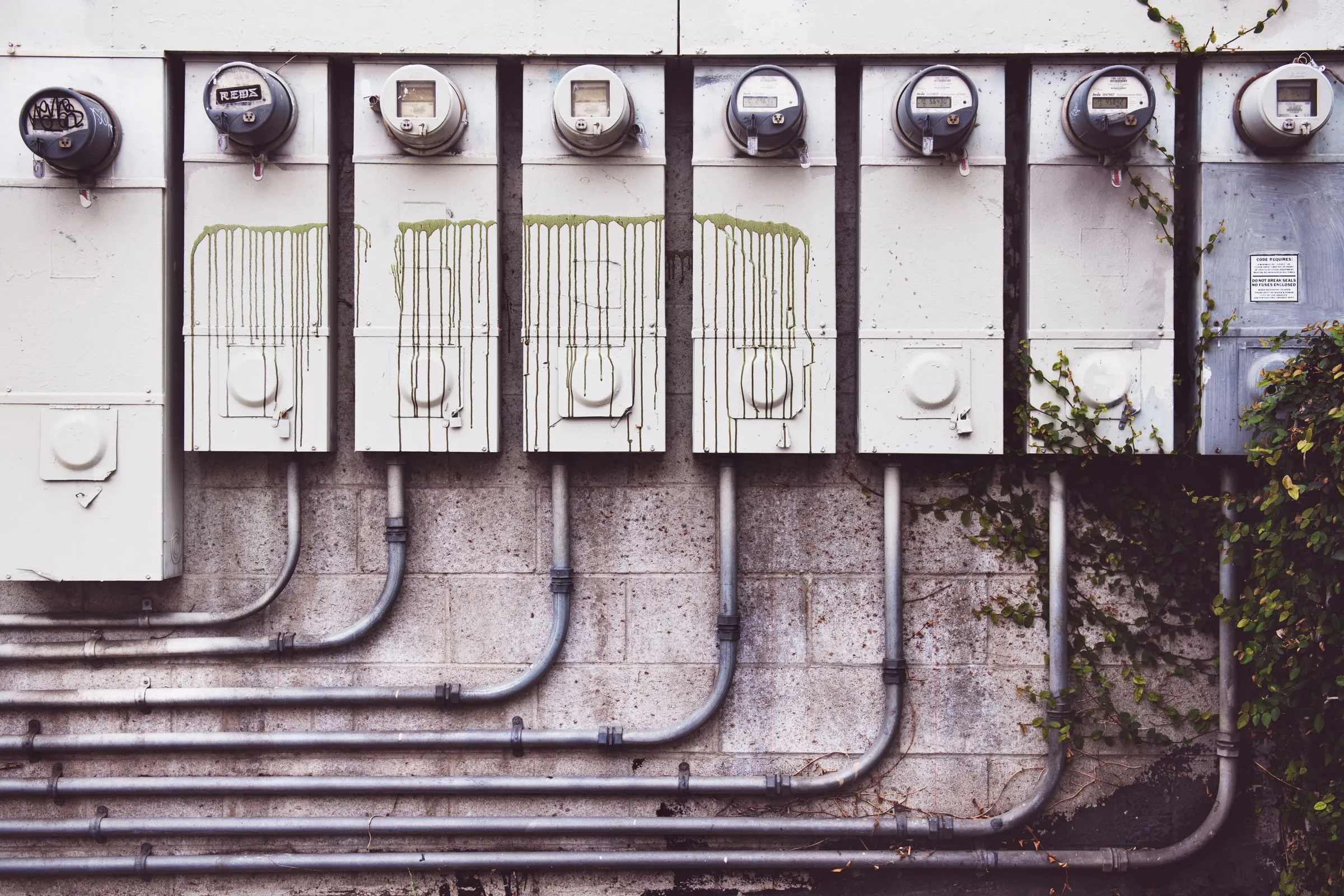
Photo: Tim Mossholder / Pexels
Estimates of the totals diverge, and honesty requires saying so. The market monitor’s $16.6 billion figure covers two auctions; advocacy groups project cumulative consumer impacts in the tens of billions through the early 2030s if nothing changes, while utilities counter that capacity is a fraction of the average bill. Both things can be true.
Who pays for the wires
The sharper policy fight is over new transmission and generation, and 2025-2026 produced a wave of special data center rate classes designed to fence off those costs.
Ohio moved first. In July 2025 the state’s utility commission approved AEP Ohio’s data center tariff, which requires new facilities above 25 MW to pay for at least 85 percent of their contracted demand whether or not they use it, under 12-year contracts with exit penalties, per Data Center Frontier. In November 2025, Virginia’s State Corporation Commission approved Dominion Energy’s new GS-5 class for customers over 25 MW, obligating them to pay for at least 85 percent of contracted transmission and distribution demand and 60 percent of generation demand, according to the American Action Forum. Pennsylvania’s PUC followed in April 2026 with a large-load tariff framework built on the principle that customers who cause new infrastructure costs should pay them directly.
The politics have gone bipartisan. In June 2026, Texas Governor Greg Abbott directed the PUC and ERCOT to shield residential ratepayers from data center infrastructure costs and to ensure new facilities “bring their own power.” MultiState counted more than 300 data-center bills filed across 30-plus states in the first six weeks of 2026, with at least 18 states weighing special rate classes. Monitoring Analytics has gone furthest of all, recommending that new data centers in PJM be required to supply their own generation entirely.
The case for the defense
Before concluding that AI is simply picking your pocket, consider the counterargument, because it has real economics behind it. A grid is mostly fixed costs. A large, flat, around-the-clock load that pays full freight spreads those costs over more kilowatt-hours and can pull average rates down. A 2026 working paper by EPRI researchers, posted to arXiv, found that a doubling of local data center capacity between 2015 and 2024 was associated with residential prices about 3.5 percent lower, all else equal.
Utilities are leaning on that logic. Duke Energy CEO Harry Sideris told analysts on the company’s Q1 2026 earnings call that its contracts make “data centers pay their fair share through minimum take provisions, deposits, refundable deposits, claw back provisions if they terminate,” with billions of dollars flowing back against fixed costs. Several utilities now argue publicly that well-structured hyperscale contracts lower bills for everyone else, a case examined by Data Center Knowledge.

Photo: Tom Fisk / Pexels
The catch, as UC Berkeley’s Energy Institute at Haas put it in September 2025, is that the benefit only materializes if serving the new load does not trigger expensive new generation, transmission, and distribution. The AI boom is triggering exactly that.
The bottom line
So, is AI raising your electric bill? In PJM territory, yes, measurably, with the market monitor’s receipts attached. Nationally, the record is messier: past data centers likely lowered rates, and the current wave will be decided less by the technology than by tariff design, contract minimums, and whether the 2026 crop of rate classes actually holds. Your bill, in other words, is being negotiated right now in a docket near you.
More in Power & Energy
All Power & Energy →
Same Reactors, More Megawatts: Google and Amazon Pay Constellation to Squeeze 1.1 GW Out of PJM's Nuclear Fleet
In six days, Amazon and Google signed 20-year contracts that fund roughly 1,080 MW of nuclear uprates at seven Constellation sites in Maryland, Illinois, Pennsylvania and New Jersey, backed by more than $7.3 billion of plant investment. Unlike most hyperscaler nuclear deals, these add electrons that do not exist today, arriving between 2028 and 2032 against a PJM shortfall of 6.8 GW that lands in 2028. Three days after the Google announcement, FERC threw out the PJM rule the deal was written to satisfy.
The Backstop That Stalled: PJM's One-Time Auction for Data Center Power Runs Into FERC
PJM was supposed to open a six-week window on September 30 to buy 6.8 GW of new power plants for data centers on 15-year contracts. FERC approved the price cap, threw out the cost allocation, called the filing a mess, and the largest grid operator in the country put the whole thing on hold.

Nuclear's Comeback: Restarts, Small Reactors, and the Gap Between Deals and Electrons
Hyperscalers have signed close to 10 gigawatts of nuclear deals, and Palisades just loaded fuel. But most of the announced capacity is either re-labeled output from existing plants or reactors that will not run until the 2030s. Here is what will actually deliver before 2030.